
Galaxea Team · Technical report
G0.7
Scaling up a fast world action model with long context.
World action models (WAMs) adapt pretrained video generators for robot control by jointly predicting future camera frames and actions, transferring physical priors learned from video into manipulation policies. Most WAMs pay a steep price for this at deployment: generating future frames before every action makes inference too slow for closed-loop control. In Fast-WAM, we showed that this bottleneck is avoidable: video prediction does its work during training by shaping the model's representations, so at test time the policy can skip video generation and decode actions directly without losing performance.
Fast-WAM was a small-scale study limited to single-frame observations. G0.7, Galaxea's new generalist robot policy, scales this recipe along two axes: extending the context window from a single observation to up to five minutes of history, and scaling pretraining to a much larger corpus of robot teleoperation and human egocentric (ego) video.
Across our evaluations, the Fast-WAM finding holds at scale. Direct action decoding from the G0.7 checkpoint matches imagine-then-act inference across simulation and real-robot benchmarks while running in 60 ms per action chunk on a single RTX 5090. Performance scales consistently with pretraining data, with human ego video driving the largest gains in zero-shot and out-of-distribution generalization. Up to five minutes of history turn G0.7 into an in-context learner capable of following human video demonstrations and tracking hidden state over time, while post-training on roughly five hours of data per task enables long-horizon manipulation such as folding shipping boxes, making lemon tea, and bagging products.
1Long context: up to five minutes of history
While most existing VLAs and WAMs condition on only one or two recent frames, G0.7 conditions on up to five minutes of observation history, maintained as clean video latents in a sliding-window KV cache. Long-context conditioning is built into pretraining from the start: G0.7 is trained autoregressively over multi-chunk sequences (each chunk comprising one video latent and 16 actions), and its context window can be further extended during downstream adaptation without architectural changes.
Beyond remembering earlier events within an episode, such as tracking an object after it is occluded, a five-minute context window enables in-context learning (ICL). Prepending a video of a person performing a task into the KV cache specifies the goal by example, allowing the robot to infer the underlying rule and continue the task autonomously. In sorting by example (Figure 2), the current camera view shows seven objects and three bins but gives no indication of which item to pick next or where it belongs; keeping the human demonstration in the KV cache resolves both decisions.
2Fast mode: actions without video generation
Every G0.7 checkpoint supports two inference paths from the same weights. In IDM mode, the model first denoises future video latents and then decodes actions conditioned on them, following the standard WAM paradigm. In Fast mode, it skips video generation altogether and denoises the 16-step action chunk directly from the cached context in five steps.
Evaluated on the same checkpoint, the two modes perform on par across all four evaluation suites (Figure 3). What changes is inference latency: on a single RTX 5090, Fast mode runs in 60 ms per action chunk in our deployed FP8 configuration (7.6× faster than IDM), and in 156 ms vs. 457 ms (2.9× faster) when benchmarked head-to-head in unoptimized BF16 eager mode. Video prediction thus serves its purpose as a training objective, shaping the representations from which actions are decoded, while generating video again at test time adds latency without improving control.
Because Fast mode reduces inference to pure action denoising, it also makes G0.7 a drop-in fit for real-time chunking (RTC): the next action chunk is denoised while the current one executes, eliminating pauses between chunks (Figure 4).
3Pretraining data: robot and human ego
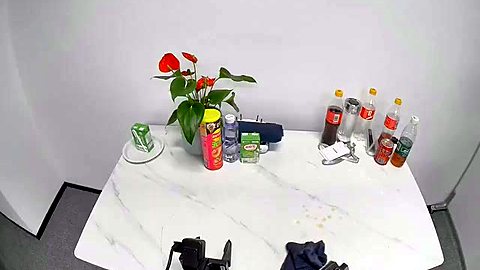
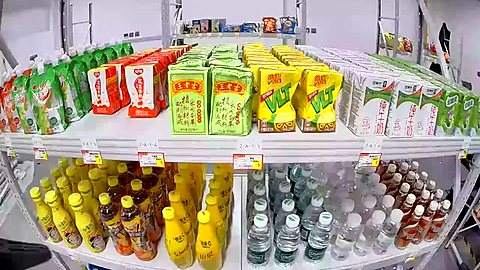
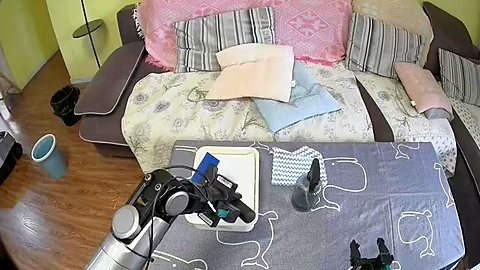
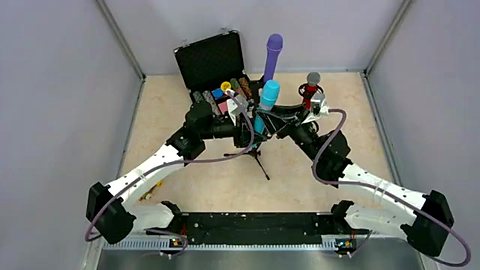
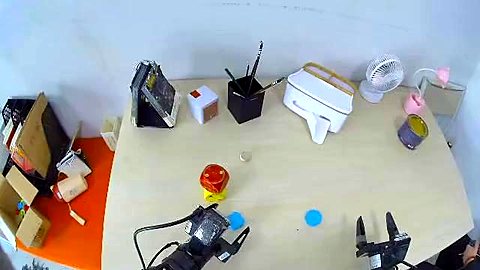
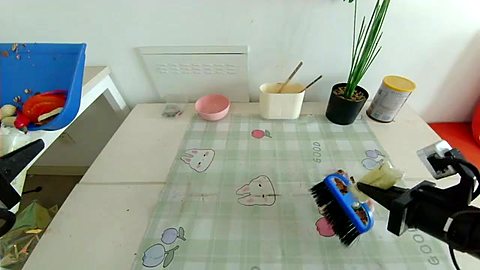
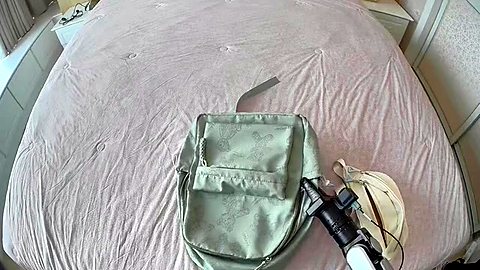
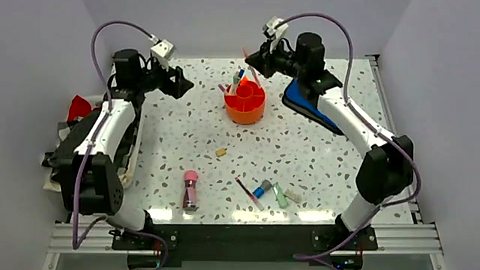
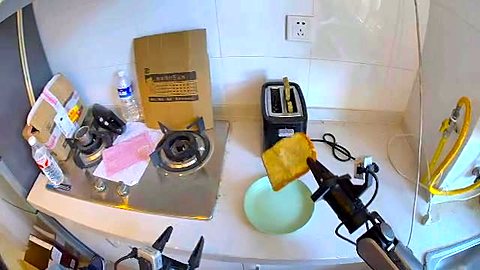
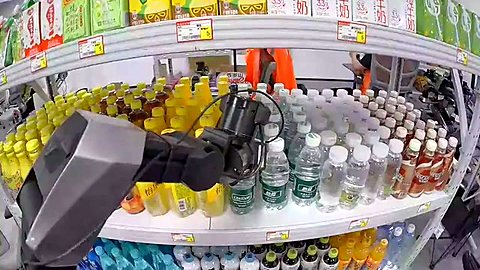
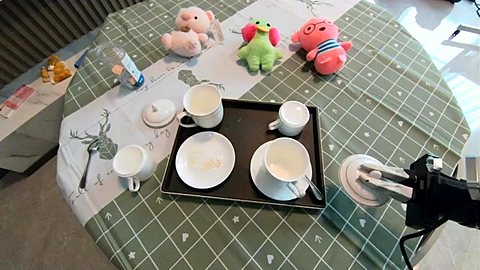
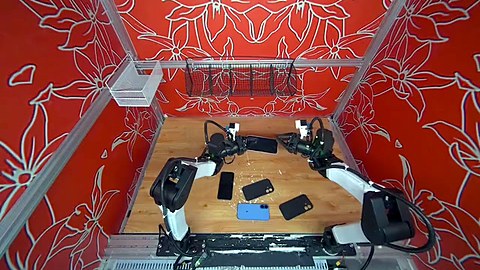
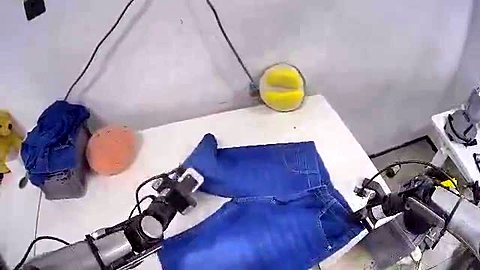
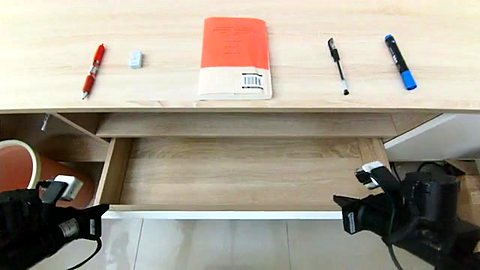
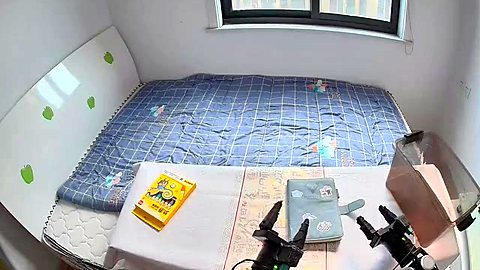
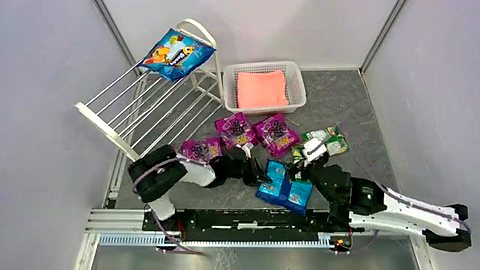
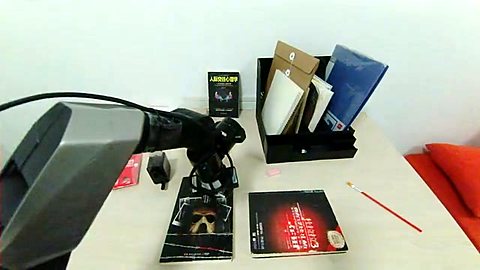
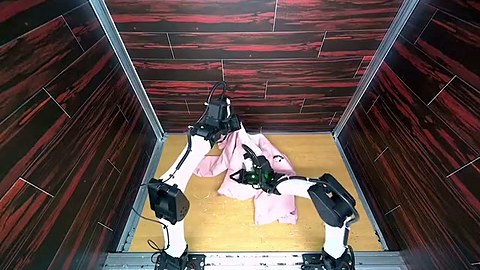
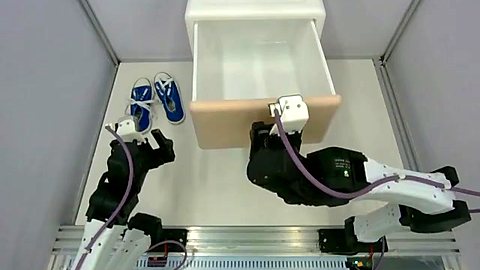
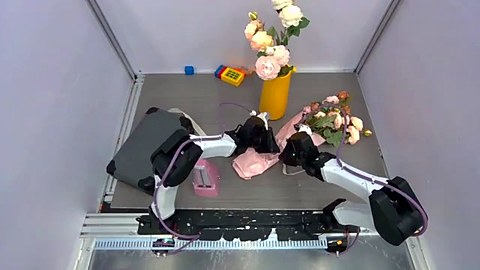
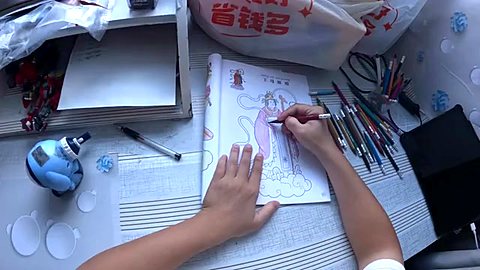
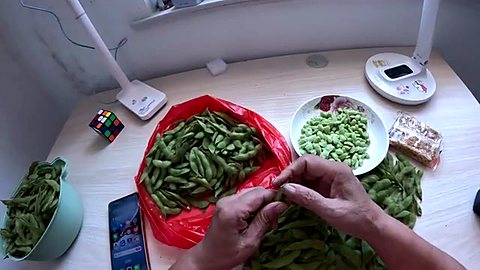
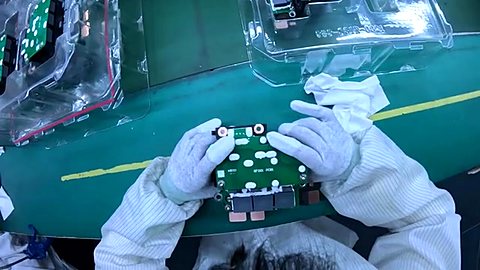
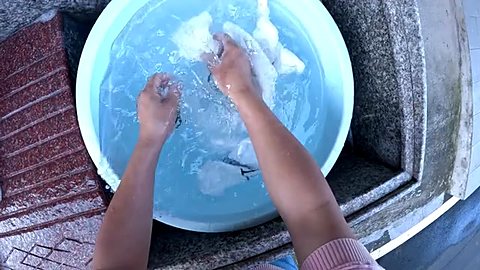
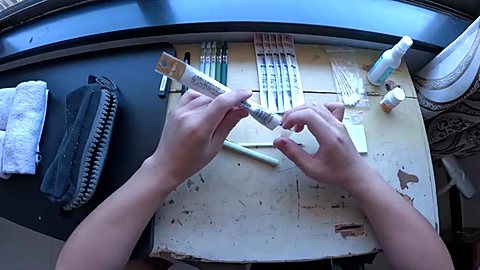
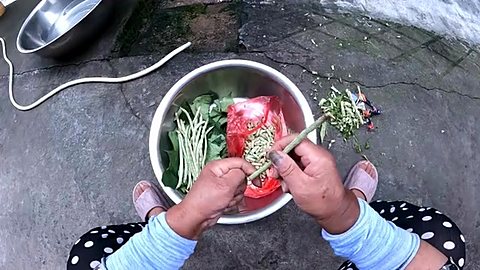
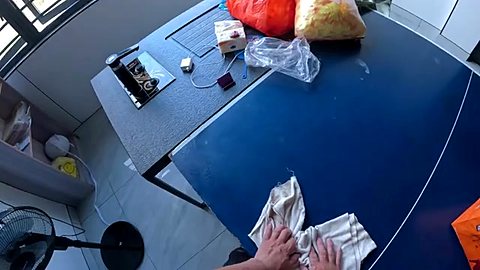

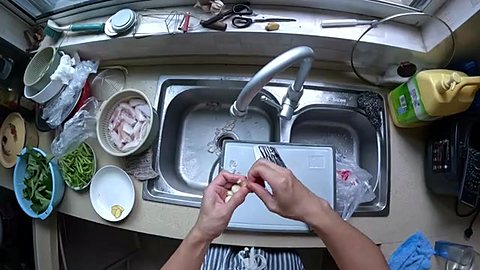
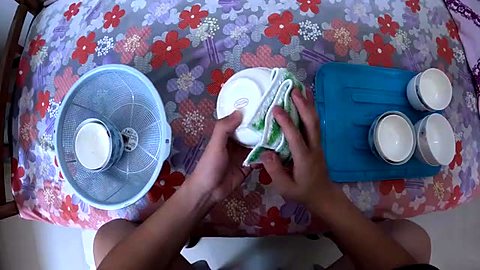
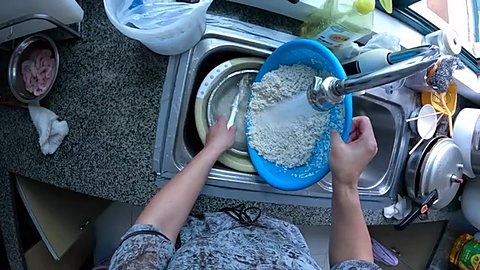

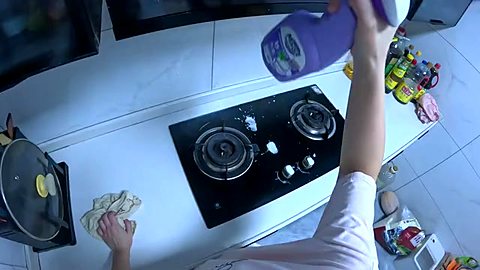
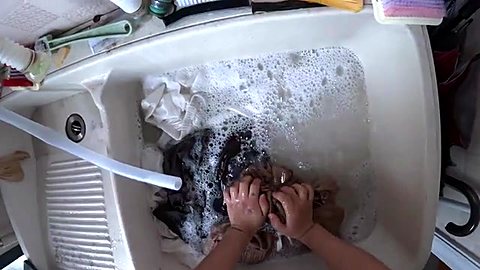
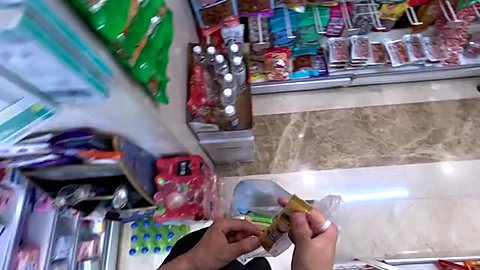
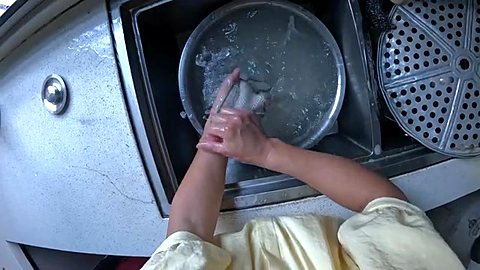
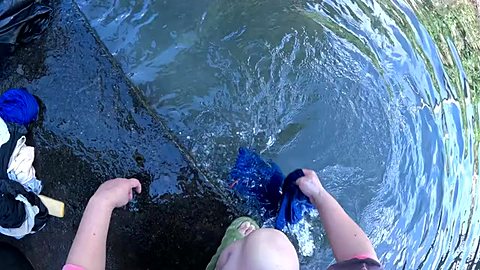
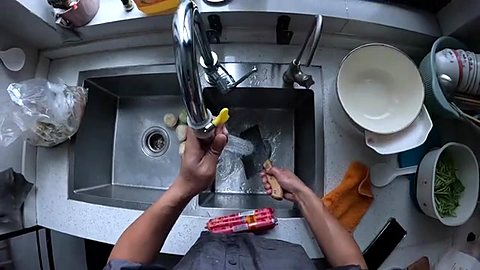
G0.7 is pretrained on a large-scale corpus of robot teleoperation and human ego video. The robot corpus combines trajectories from our Galaxea R1 Pro and R1 Lite fleets with public datasets including DROID, RoboMIND, and BridgeData. The ego corpus consists of first-person video of everyday manual work captured with head-mounted cameras.
Hierarchical language annotation. Teleoperation episodes are annotated at three temporal scales (Figure 5): a complex instruction for the full episode, compound instructions for sub-goals, and atomic labels covering a few seconds of motion. Relying on episode-level instructions alone creates a supervision mismatch. Twenty seconds into an episode labelled “prepare toasted bread and pour a beverage”, for instance, the arm is pushing a single slice into the toaster, a motion the episode label never names. Supervising each training window at its matching granularity eliminates this mismatch between high-level language and low-level actions, and strengthens fine-grained instruction following so the same policy can execute both short atomic commands and multi-stage goals. Episodes also carry quality scores for motion smoothness and annotation reliability to filter out pause-heavy trajectories.
Actions from ego video. To train on human ego video with the same objective as robot data, we built a custom data pipeline that extracts 3D hand trajectories from raw video and maps each hand into a unified end-effector action representation: the 6-DoF wrist pose aligned to the tool-center point (TCP) convention of the R1 gripper (+Z along the fingers) together with the 3D positions of all five fingertips (Figure 6). Human hands are treated as an additional embodiment under the joint video-action objective, while clips with noisy hand tracking still contribute to video prediction.
Data scaling. To isolate the effect of pretraining scale and data composition, we compare three checkpoints that share the same architecture and differ only in their pretraining data:
| G0.7-20% | About 20% of the robot teleoperation data |
|---|---|
| G0.7-Robot | The full robot corpus, without human ego video |
| G0.7 | The full corpus, combining robot and human ego data |
Performance improves across all four evaluation suites as pretraining scales from G0.7-20% to G0.7-Robot and G0.7 (Figure 7). Expanding the robot corpus from G0.7-20% to G0.7-Robot lifts the five-suite simulation mean from 56.2% to 66.6% and real-robot post-training progress from 81.0% to 85.9%; adding ego video in G0.7 brings them to 70.8% and 86.9%, respectively. Zero-shot deployment depends on scale the most: G0.7-20% almost never succeeds without task data (0 of 25 trials on R1 Pro and 1 of 50 on R1 Lite). Ego data has the largest impact where the policy must generalize beyond its training distribution: from G0.7-Robot to G0.7, zero-shot success on R1 Lite jumps from 12% to 54%, and out-of-distribution success on in-context learning tasks rises from 50% to 73%.
4Experiments
We evaluate G0.7 (running in Fast mode) across four settings: public simulation benchmarks, zero-shot deployment on real robots, in-context learning, and post-training on real-world manipulation tasks.
Across these evaluations we compare against leading open-source and internal baselines: π0.5, the most widely adopted open-source VLA; OpenWAM, the state-of-the-art open-source WAM; and G0.5, our previous-generation VLA. In zero-shot experiments we also include Dream-1, a recent WAM from Dream Labs designed for zero-shot bimanual control, and in in-context learning we compare against Long-WAM, a WAM built specifically for long-horizon memory. Figure 8 summarizes the overall comparison: G0.7 leads on every axis.
4.1Simulation benchmarks
We evaluate on five public benchmark suites that probe distinct capabilities. LIBERO tests tabletop manipulation alongside three robustness suites (LIBERO-Plus, LIBERO-Pro, and LIBERO-Para) that perturb scene layout, task structure, and language instructions; we report the mean of these four as LIBERO w. OOD. RoboTwin 2.0 evaluates bimanual manipulation in the clean-to-random (C2R) setting under heavy domain randomization, VLABench focuses on semantic instruction following, RMBench tests memory-dependent manipulation, and RoboDojo spans 42 challenging tasks across generalization, memory, precision, and long-horizon control. Each model is post-trained on the respective benchmark's training split and evaluated under its standard protocol.
Across the five benchmark suites (with LIBERO w. OOD counted once), G0.7 achieves a mean score of 70.8%, outperforming OpenWAM (43.9%), G0.5 (39.2%), and π0.5 (33.9%). The advantage is most pronounced on RMBench, where G0.7 reaches 86.2% while single-frame baselines stay below 12%. G0.7 also leads by a wide margin on RoboTwin 2.0 (79.4% vs. 69.0% for OpenWAM) and VLABench (63.3% vs. 58.9%). While standard LIBERO is near saturation across models (97%–99%), G0.7 separates itself on the perturbation suites, reaching 92.5% on LIBERO-Plus (vs. 85.7%) and 88.3% on LIBERO-Para (vs. 71.4%). On RoboDojo, G0.7 scores 41.46, more than double the strongest baseline (18.95 for G0.5).
4.2Zero-shot on real robots
To test out-of-the-box generalization without any task-specific post-training, we deploy the pretrained checkpoints directly on real-world pick-and-place (PnP) benchmarks across two Galaxea platforms: 25 trials on R1 Pro and 50 trials on R1 Lite.
G0.7 succeeds in 12 of 25 trials (48%) on R1 Pro and 27 of 50 trials (54%) on R1 Lite, outperforming both G0.5 (36% and 46%) and Dream-1 (32% on R1 Lite). Zero-shot deployment is where human ego pretraining makes the sharpest difference: without ego data, G0.7-Robot succeeds in only 6 of 50 trials (12%) on R1 Lite (Figure 7), confirming that visual and behavioral diversity from human video transfers directly to zero-shot robot control.
4.3In-context learning
We next test whether G0.7 can act on information available only through extended visual contexts and generalize to unseen task configurations. We evaluate two complementary capabilities: long-horizon visual memory and one-shot human demonstration following. In the shell game, the robot must track hidden targets through repeated shuffling. In sorting by example, the robot must infer human intent from sparse cues in a single demonstration and generalize to unseen configurations.
Benchmark and generalization settings. Models are post-trained on task demonstrations and evaluated over 15 trials each in distribution (ID) and out of distribution (OOD). For the shell game, training and ID evaluation use three cups with 1–3 swaps, while OOD evaluation covers unseen cup types, target objects, layouts, cup counts (4–5 cups), shuffling styles, and longer sequences (≥6 swaps). For sorting by example, training and ID evaluation focus on single-object sorting by demonstration, while OOD evaluation includes unseen objects, object counts, container colors and shapes, spatial layouts, and multi-object sequential sorting. Alongside standard post-training, we evaluate ICL mid-training, an intermediate stage between pretraining and task post-training that extends G0.7's context window and exposes the model to longer in-context demonstration sequences. We compare against Long-WAM, a competitive long-context WAM baseline, as well as G0.5 and π0.5. All baselines use aligned task post-training settings, with G0.5 and π0.5 also receiving multi-frame visual contexts.
Shell gameA person hides an object under a cup and shuffles the cups. G0.7 tracks the hidden target and lifts the correct cup, including with unseen cups, objects, layouts and shuffling styles. Autonomous, 3× speed except where marked.
Sorting by exampleA person shows where a few objects go, and G0.7 follows the human intent to sort objects into matching containers, including with unseen objects, object counts and containers. Autonomous, 2× speed except where marked.
Native long-context pretraining enables stronger downstream ICL. On the shell game, G0.7 achieves 93.3% ID and 80.0% OOD, outperforming Long-WAM (53.3% / 26.7%), G0.5 (33.3% / 20.0%), and π0.5 (26.7% / 20.0%). On sorting by example, G0.7 reaches 93.3% ID and 66.7% OOD, compared with Long-WAM (60.0% / 40.0%), G0.5 (13.3% / 6.7%), and π0.5 (6.7% / 6.7%). Despite receiving multi-frame visual contexts, G0.5 and π0.5 remain substantially behind G0.7, highlighting the importance of learning to effectively utilize extended visual histories rather than simply providing additional context frames.
Human-to-robot transfer via egocentric pretraining. Across both post-training settings, G0.7 substantially outperforms G0.7-Robot on OOD evaluation, improving mean OOD success from 50.0% to 73.3% without mid-training and from 66.7% to 93.3% (+26.7 percentage points) with ICL mid-training. These gains suggest that egocentric human video pretraining learns transferable representations of human interactions, facilitating the transfer of human intent and task knowledge to downstream robotic manipulation.
Effect of ICL mid-training. ICL mid-training further improves mean OOD success from 50.0% to 66.7% on G0.7-Robot and from 73.3% to 93.3% on G0.7. Learning from paired human–robot demonstrations helps strengthen the correspondence between human intent and robot execution, enabling more reliable demonstration following across unseen configurations. Together with egocentric video pretraining, ICL mid-training brings G0.7 to 96.7% ID and 93.3% OOD success across both tasks.
4.4Post-training on real-world tasks
Finally, we evaluate how efficiently G0.7 adapts to new physical skills across two regimes: few-shot tool use and long-horizon production tasks. For tool use, we collect 20 demonstrations per tool across four tasks: scooping food with a spatula, lifting a bowl with tongs, scanning a barcode with a handheld scanner, and sweeping a table with a small broom. For long-horizon production tasks, we post-train on roughly five hours of data per task to fold shipping and gift boxes from flat cardboard, make lemon tea, and bag retail products. These workflows run for several minutes and involve deformable materials and liquids, where compounding errors easily cause failure.
All models are post-trained on identical datasets and evaluated by both overall success rate and task progress (the fraction of task stages completed per trial).
Folding a shipping boxFolding a flat sheet into a box, packing it and closing the flaps with both arms. About five hours of post-training data. Autonomous, 1× speed.
Making lemon teaPounding the lemon with a mallet, pouring water, stirring and handing over the drink. About five hours of post-training data. Autonomous, 1× speed.
Assembling a gift boxFolding and assembling a small gift box. About five hours of post-training data. Autonomous, 1× speed.
Bagging productsOpening a drawstring bag, loading products one by one, pulling it closed and moving it aside. About five hours of post-training data. Autonomous, 1× speed.
Tool useScanning a product, scooping food with a spatula, lifting a bowl with tongs and sweeping the table: four tools learned from 20 demonstrations each. Autonomous, 1× speed.
Long-horizon production tasks. On shipping-box folding, G0.7 achieves a 90% success rate and 95% task progress from five hours of demonstrations, compared with 75% success (79% progress) for G0.5 and 55% success (59% progress) for π0.5, while OpenWAM fails to complete a full box (29.7% progress). On lemon tea, G0.7 completes every trial (100% success and task progress), compared with 80% success (88.5% progress) for G0.5 and 45% success (72% progress) for π0.5, while OpenWAM never finishes the drink (33.5% progress). On product bagging, G0.7 reaches 63% success and 84% task progress, compared with 50% success (52% progress) for G0.5 and 20% for π0.5, while OpenWAM makes no progress.
Few-shot tool use. From 20 demonstrations per tool, G0.7 reaches 82% mean task progress across the four tools, outperforming G0.5 (58%), π0.5 (35%), and OpenWAM (17%). G0.7 maintains high progress across all four tools (93% on spatula scooping, 84% on table sweeping, and 76% on both tong grasping and barcode scanning), whereas π0.5 and OpenWAM make little or no progress (0%–2%) on precision-critical tasks such as lifting a bowl with tongs.
5Summary
G0.7 demonstrates that the Fast-WAM recipe scales effectively to five-minute context windows and large-scale robot and human ego pretraining. Using video prediction as a training objective while decoding actions directly at test time matches imagine-then-act control at a fraction of the latency (60 ms per chunk), enabling smooth closed-loop execution with real-time chunking. Native long-context pretraining equips the policy with both episode memory and video-based in-context learning, while the combined robot and ego corpus provides a strong foundation for zero-shot deployment and rapid post-training on complex real-world manipulation tasks.