- Home
- Models
- Products
- Solutions
- About Us
- Contact Us
- 中文

June 25, 2025
BAAI Conference Talk | Galaxea’s Zhao Xing: VLA vs. WAM — What’s the Real Answer?
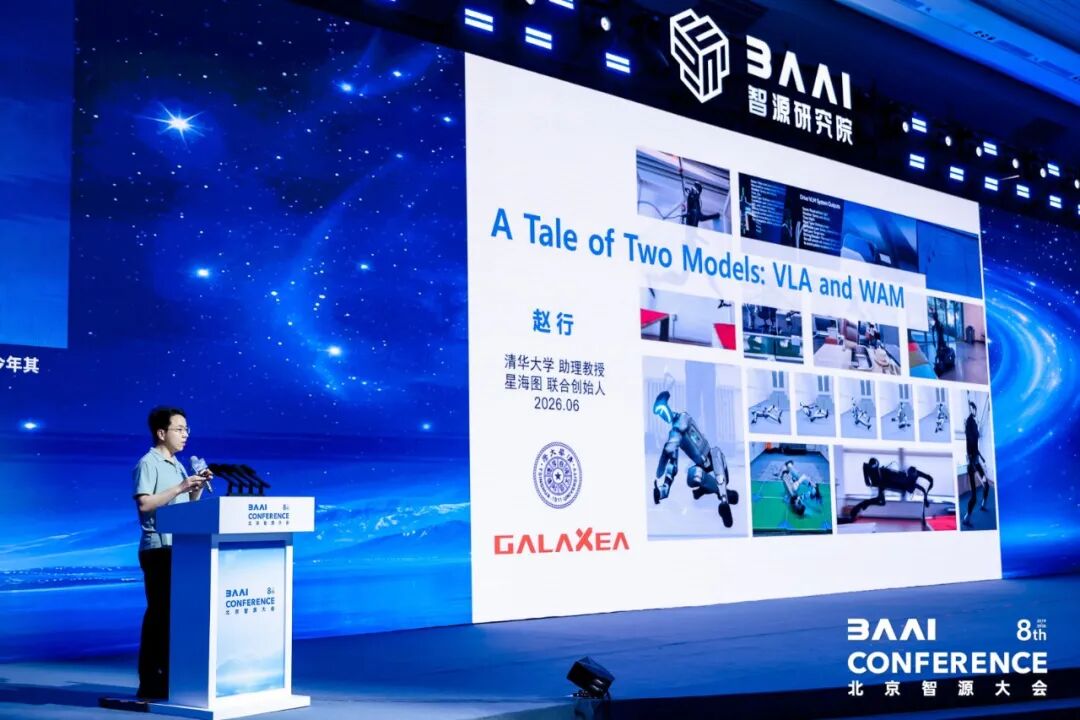
The debate over how large AI models should guide robotic actions has never stopped evolving. Should we equip models with powerful semantic understanding and generalization capabilities through Vision-Language-Action (VLA) architectures? Or should we enable them to imagine the physical world and predict its dynamics through World Action Models (WAMs)?
This is more than an academic debate. It represents a strategic choice that could shape the technological direction of the next generation of robotics.
At the 2026 Beijing Academy of Artificial Intelligence (BAAI) Conference, Galaxea Chief Scientist Zhao Xing shared his insights from the forefront of embodied AI research. He presented Galaxea's exploration and validation of two technical approaches—autoregressive VLA and World Action Models—and offered an in-depth look at the company's recently open-sourced G0.5 embodied foundation model.
How did G0.5 set new state-of-the-art (SOTA) records across seven global benchmarks? More importantly, how did a single general-purpose model significantly outperform the previous winning solution based on an ensemble of multiple models on BEHAVIOR-1K, one of the industry's most challenging benchmarks for long-horizon mobile manipulation in realistic household environments?
What are the key technical innovations behind these results?
The following is an edited transcript of Zhao Xing's presentation at the BAAI Conference.
VLA or WAM? The Most-Watched Technical Debate of the Year
One of the most frequently discussed questions in embodied AI this year is whether VLA or WAM represents the better approach.
That is also the focus of my presentation today: A Tale of Two Models—VLA and WAM.
At first glance, VLA and WAM appear quite different. But when we examine their architectures, they share significant similarities. Both take vision and language as inputs and generate actions as outputs. Their underlying structures are also remarkably similar, with both built on Transformer architectures.
Over the past few years, Galaxea has explored both approaches. Today, I'd like to share some of our thinking.
Why Are We Still Betting on Autoregressive VLA?
The mainstream approach to VLA in recent years has been to add a diffusion head to an existing Vision-Language Model (VLM), creating a VLA model that primarily generates actions through diffusion.
Earlier VLA models, including RT-1, RT-2, and OpenVLA, actually followed a purely autoregressive approach. However, this direction did not achieve widespread success over the following years. With the emergence of π0 and π0.5, the industry gradually shifted toward diffusion-based VLA architectures.
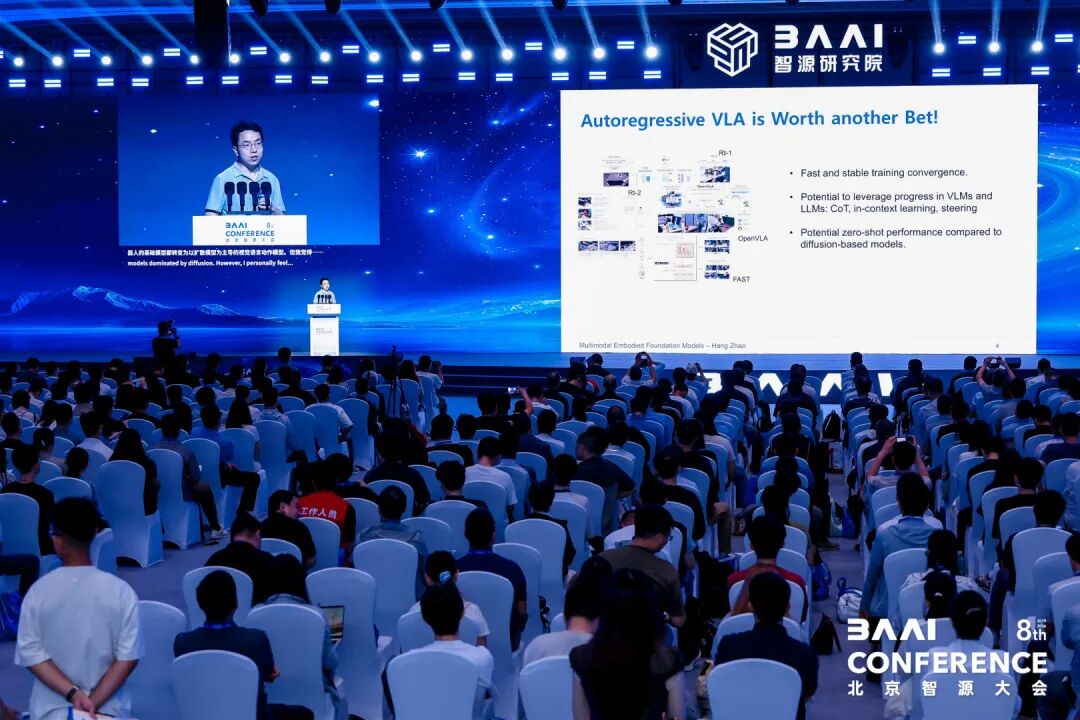
Nevertheless, we believe autoregressive VLA deserves another serious investment.
There are three reasons behind this judgment.
First, previous research, including π0-FAST, has demonstrated that autoregressive models can offer more efficient training methods and faster convergence.
Second, autoregressive architectures allow us to leverage advances from language models and vision-language models, including chain-of-thought reasoning, in-context learning, and steering.
Third, after language-model pretraining, autoregressive models can exhibit zero-shot semantic generalization.
These are capabilities that we rarely see in diffusion-based models such as DiT.
However, one critical component of autoregressive VLA has long been overlooked: the action tokenizer.
Why does it matter?
Language is inherently discrete. Autoregressive models can naturally generate language one token at a time. Robotic actions, however, are different. Like visual signals, they are continuous signals used to control a robot.
Teaching a language model to generate actions is essentially like teaching it another language.
Before we can do that, we need to solve a fundamental problem: How can continuous action signals be converted into discrete tokens so they can be trained together with language?
We have conducted a series of studies around this question.
1. From FAST to FASTer: The First Evolution of Action Tokenization
We examined several existing approaches to converting continuous actions into discrete tokens.
The first is direct quantization, which converts numerical action values into discrete tokens. However, this often produces highly redundant action sequences.
The second uses neural network architectures such as VAE and VQ-VAE to generate discrete action tokens. These methods, however, frequently suffer from relatively poor reconstruction accuracy.
The most relevant prior work is FAST, which performs quantization in the frequency domain.
Its underlying principle is similar to JPEG image compression. Different images contain different amounts of information, and the same applies to actions. Complex actions are encoded into longer sequences, while simpler actions are compressed into shorter ones.
This led us to another question: Could we develop a better way to manage these variable-length encodings?
To address this, we proposed FASTer.
We unfold the robot's action space along both the temporal dimension and the degrees-of-freedom dimension, creating a two-dimensional matrix. We then divide this matrix into groups, much like processing an image, and apply compression and quantization techniques such as vector quantization (VQ) and residual vector quantization (RVQ).
Finally, we optimize reconstruction accuracy across both the time and frequency domains.
By integrating FASTerVQ into mainstream VLA models, we achieve higher control frequencies and stronger model performance. The tokenizer can also be combined with virtually any VLA backbone.
2. Beyond Reconstruction Accuracy: Redefining a Good Tokenizer Through Conditional Entropy
We then reconsidered the fundamental purpose of an action tokenizer.
What problem are we ultimately trying to solve? Have previous approaches focused too narrowly on the wrong objective?
Historically, action tokenizers have primarily been evaluated on reconstruction quality. In other words, after compressing and decompressing an action sequence, how accurately can the original trajectory be recovered?
But this overlooks a more important question: How much does the tokenizer actually help the model learn actions?
When we consider action learning from this perspective, optimizing conditional entropy becomes a more meaningful objective.
We break this down into four dimensions.
Stability. Small perturbations in an input action trajectory should result in minimal changes to the compressed token sequence. The encoding must remain sufficiently stable.
Capacity. A good compression system should have a reasonable, bounded, and compact vocabulary and sequence length. Image compression can readily achieve compression ratios of 50–100×, while video compression can reach 100–1,000×. For robotic actions, our goal is to achieve compression ratios of approximately 10–50×.
Semantic alignment. Actions do not exist in isolation. They always involve interactions with objects and environments, so their representations should align with semantic information.
Cross-embodiment transfer. The tokenizer should be applicable to robots with different physical configurations.
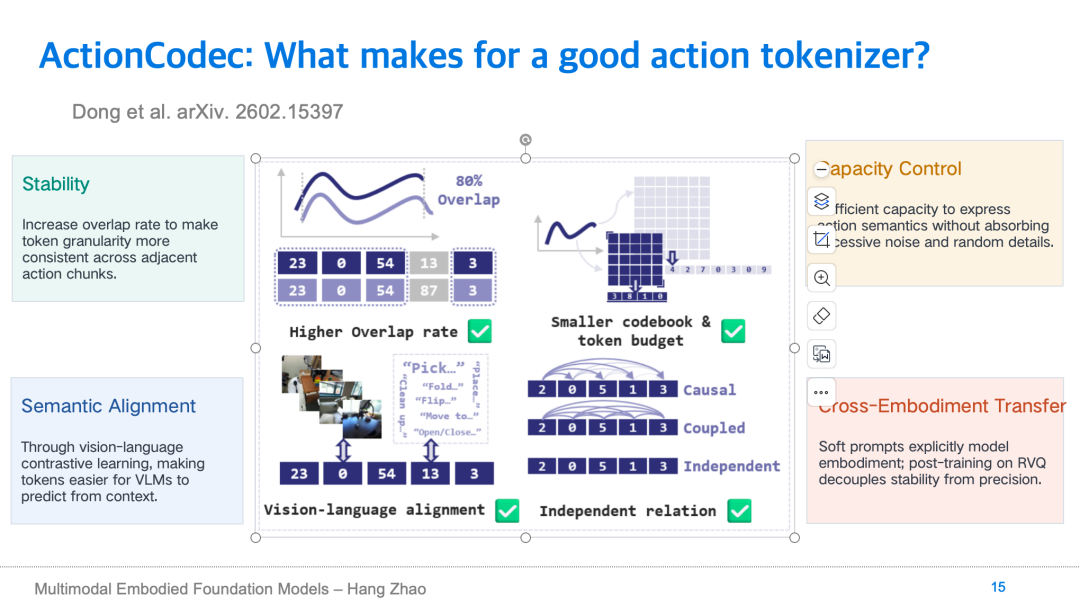
Based on these four objectives, we developed ActionCodec.
Our architecture draws inspiration from the Perceiver framework.
Specifically, the model takes two types of inputs.
The first is a soft prompt, which can describe the robot's name, ID, control frequency, input sequence length, current task, and associated dataset using natural language.
The second is a frequency embedding with temporal position information, allowing the model to better understand the sequential structure of the input signals.
Both inputs are processed through a Perceiver-based Transformer, which ultimately produces a fixed-length action token representation.
ActionCodec is trained using multiple loss objectives corresponding to our optimization goals. These include reconstruction loss, a consistency objective that minimizes encoding changes under temporal perturbations, a CLIP-based loss for semantic alignment, and additional regularization terms.
This design minimizes entropy while maintaining high trajectory reconstruction accuracy.
In our experiments, ActionCodec outperformed previous action tokenizers.
Building on this foundation, Galaxea developed its next-generation VLA foundation model, G0.5.
G0.5: Galaxea's Answer to VLA Foundation Models
All the demonstrations shown in the video are zero-shot.
That means the capabilities were achieved through pretraining alone, without any additional post-training.
To make the model perform these tasks, all we need is prompt engineering, or steering. We can type instructions using a keyboard, combining different verbs and objects into natural-language commands, and the model can execute a series of long-horizon tasks.
So what does the G0.5 architecture look like?
The answer is surprisingly simple.
We take a VLM, introduce a new action vocabulary, and transform it directly into a VLA model.
Unlike previous VLA architectures, G0.5 does not require an additional action head.
For example, π0.5 uses a separate action expert during training. Our approach is different: we treat actions as another language and teach the language model to generate them directly.
As a result, a single unified set of VLA parameters handles visual processing, language understanding, reasoning, and action generation.
In a discrete autoregressive VLA model, the action tokenizer is the most critical component.
G0.5 uses ActionCodec as its tokenizer. After decoding, it produces a unified 27-dimensional action space that can accommodate different robotic embodiments.
When executing a task, the model can generate its own internal chain of thought (CoT), including subtask decomposition, object detection through bounding boxes, 2D motion planning, 2D trajectories, and action hints.
For example, consider a task that requires placing a towel in a sink and turning on the faucet.
The model generates robotic control signals, such as left control and left gripper, to perform the necessary actions.
A humanoid robot may have hundreds of joints, but our model does not need to autoregressively generate actions for every joint at every step.
If a joint does not need to move, the model can simply omit its action output. In this example, the right-hand actions are dropped.
A common concern is whether autoregressive models are inherently slow, since diffusion models can denoise an entire action sequence simultaneously.
Our answer is no.
There is substantial room for optimization in autoregressive architectures. We can skip action generation for inactive joints and use acceleration techniques from language modeling, such as speculative decoding.
Our experiments show that VLA inference latency can be reduced to just a few hundred milliseconds.
G0.5 is a pretrained foundation model that has achieved strong results across seven benchmarks.
Among these, my personal favorite is BEHAVIOR-1K.
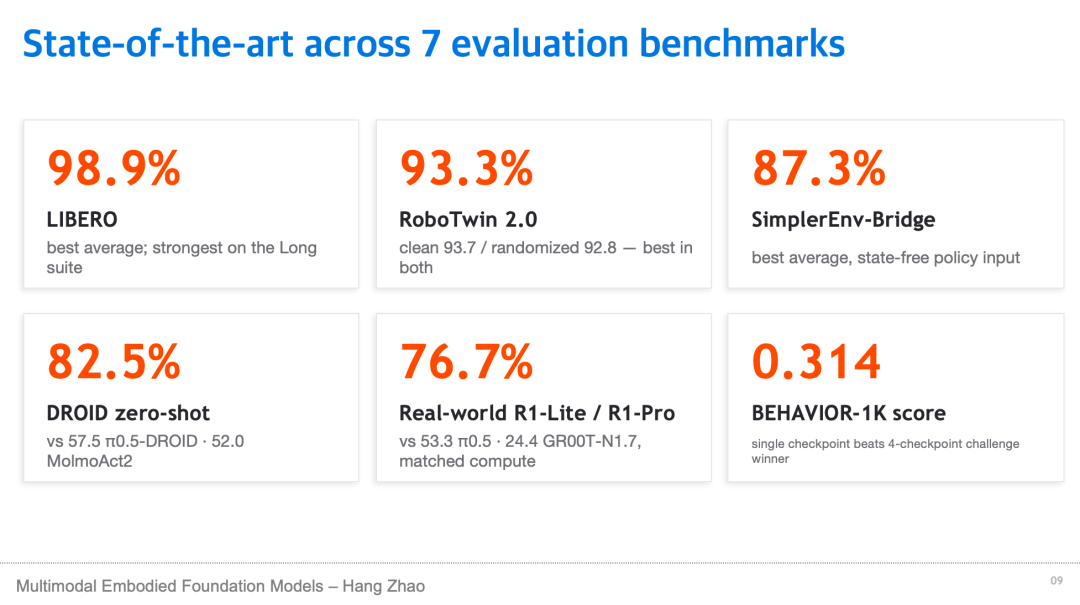
BEHAVIOR-1K is a robotic evaluation benchmark developed by the research team led by Fei-Fei Li at Stanford University.
It includes a large-scale collection of tasks reflecting activities people would like robots to perform in everyday life.
The researchers surveyed people with a simple question: “What would you like a robot to do in your home?”
Based on the responses, they developed a dataset and benchmark covering a wide range of household activities.
G0.5 can perform highly complex, long-horizon tasks within this benchmark, such as organizing cluttered tabletops and tidying laundry areas.
All these results were achieved with just one round of lightweight fine-tuning on the G0.5 foundation model.
Revisiting WAM: Is Video Generation Really Necessary?
One of the pioneering works in World Action Models was UniPi.
Its basic idea was to use an image generation model to predict a future image, then apply an inverse dynamics model (IDM) to infer the corresponding robotic action, which the robot would subsequently execute.
The advantage is straightforward: if the video generation model generalizes well, the actions derived from its predictions may also generalize well.
The drawback is equally clear.
If the generated future images are poor, the resulting actions will also be poor. This is a common weakness of non-end-to-end or modularly assembled architectures.
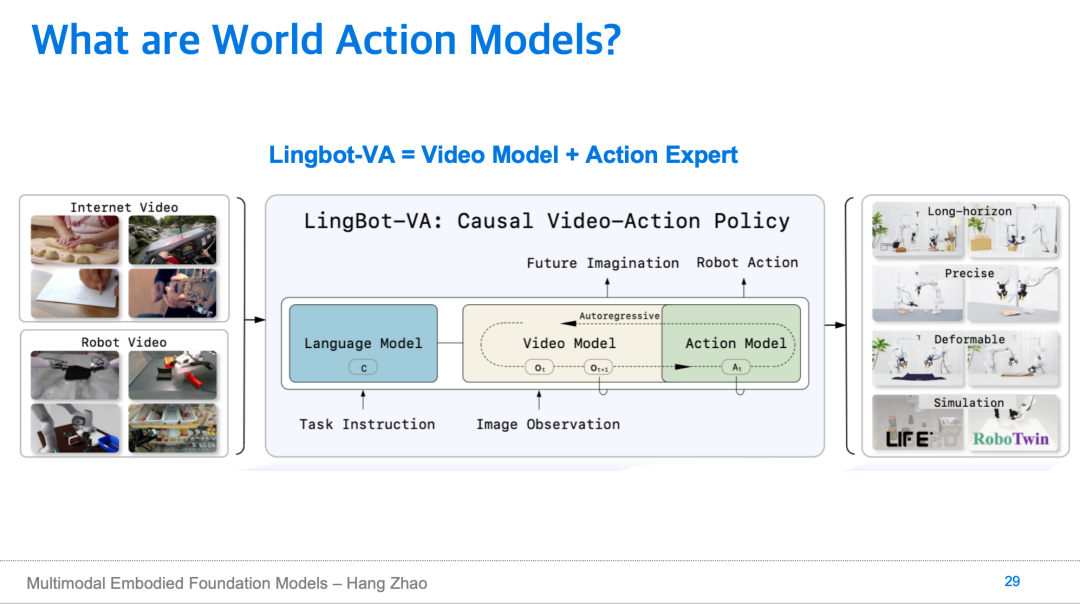
This year, research such as DreamZero and LingBot-VA introduced a different approach.
By attaching an action expert to a video generation model and jointly training the components using a Diffusion Transformer, researchers can build end-to-end robotic models.
Architecturally, these models are remarkably similar to diffusion-based VLA.
In diffusion VLA, an action expert is added to a pretrained vision-language foundation model. In WAM, an action expert is added to a pretrained video generation model.
Both approaches seek to leverage the capabilities already learned by a larger pretrained model.
WAMs can perform well because video generation models have already acquired useful representations of spatial relationships, temporal dynamics, and physical interactions.
However, these architectures also have a significant limitation: they depend on video generation, which is computationally expensive and often slow.
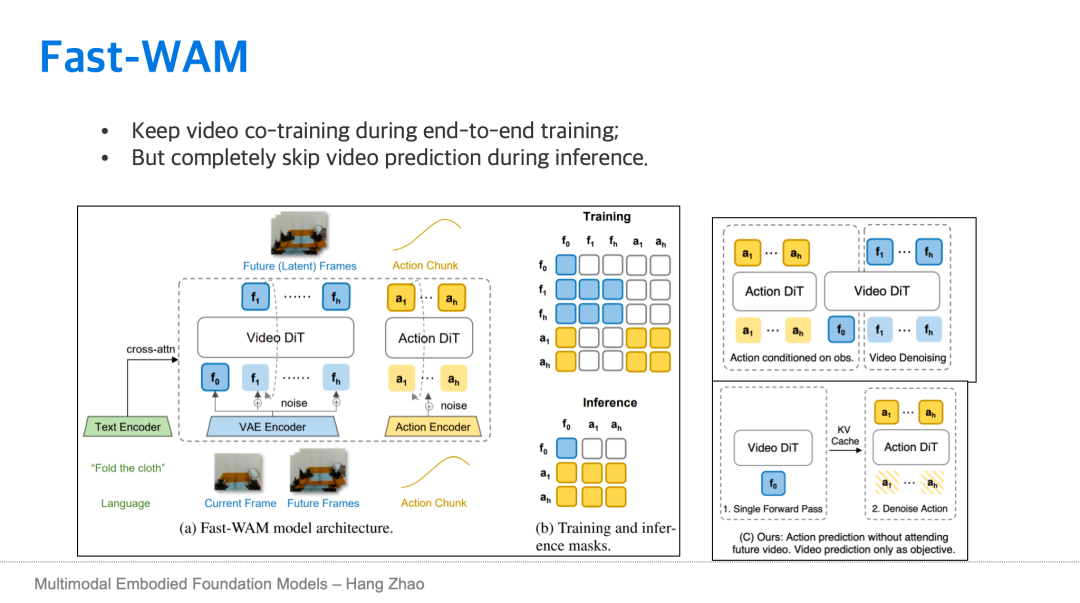
In our recent work, we reconsidered the role of future-video generation in WAMs.
We broke the problem into two questions.
1. During training, does video generation supervision help the model learn better representations?
2. During inference, does generating future video enable more accurate predictions of future states, allowing the IDM to infer better actions?
I believe representation learning is the more important factor.
Many researchers in computer vision would agree that the generated image itself is not necessarily the most valuable outcome. What matters is whether the neural network learns a useful underlying representation.
If that is true, then video generation in WAM training is conceptually similar to the co-training objectives used in VLA models.
In VLA training, we do not simply teach the model to output action trajectories. We may also train it to predict bounding boxes or decompose tasks into subtasks.
Similarly, in WAM training, although the ultimate objective is action generation, learning to predict future video can help the model understand what is likely to happen next.
The latent actions associated with those future events are closely related to the explicit actions a robot can execute.
After extensive experimentation, we found that the essential value of World Action Models lies in learning implicit representations, while explicitly generating future video during inference can waste substantial computational resources.
By modifying the attention mask during training and eliminating explicit future-video prediction at inference time, we can significantly accelerate WAM inference.
In other words, explicitly generating future video during inference is not necessarily essential.
Looking Ahead: VLA and WAM Are Not Competing Endpoints, but Paths Toward Convergence
To summarize today's presentation, I want to highlight two key points.
First, we believe VLA offers powerful semantic generalization capabilities.
By removing the conventional action expert and developing a native autoregressive VLA architecture, we can achieve strong generalization through a more unified model design.
Second, while World Action Models have become one of the most discussed topics in embodied AI, explicitly predicting future video may not be a necessary part of their architecture.
Looking ahead, we do not see VLA and WAM as mutually exclusive approaches.
Each has distinct strengths.
VLA excels in semantic understanding and generalization, while World Action Models offer valuable capabilities in spatial understanding and physical dynamics modeling.
We believe the future will likely involve combining these strengths into a single unified architecture.
There are already promising developments in this direction.
For example, the recently released Cosmos 3 explores combining VLA and world models through a mixture-of-Transformers architecture and has demonstrated impressive results.
I believe we will eventually discover an architecture that is even more unified, more capable, and more efficient than Cosmos 3.
Thank you.